
vrpr is a tidyverse-style interface to the PyVRP vehicle-routing solver.
You build a model by piping together depots, clients and vehicle types,
then call vrp_solve(). The heavy lifting runs in PyVRP’s
C++ core (rewired with cpp11), so there is no Python
dependency.
A first CVRP
The capacitated VRP (CVRP) is the base case: clients have a
demand, vehicles a capacity, and we minimise
total distance. The data boundary is a tibble.
set.seed(1)
clients <- tibble::tibble(
  x = round(runif(20, -50, 50)),
  y = round(runif(20, -50, 50)),
  demand = sample(5:15, 20, replace = TRUE)
)

model <- vrp_model() |>
  add_depot(x = 0, y = 0) |>
  add_clients(clients) |>
  add_vehicle_type(num_available = 5, capacity = 50)

res <- vrp_solve(model, stop = max_iterations(500), seed = 1, display = FALSE)
res
#>
#> ── vrpr result ─────────────────────────────────────────────────────────────────
#> • cost 567 - feasible
#> • 5 routes - 20 clients
#> • 500 iterations - 0.11s
Inspect the result with cost(), routes() (a
tidy long table) and summary():
cost(res)
#> [1] 567
head(routes(res))
#> # A tibble: 6 × 10
#>   route_id depot position activity client shipment  trip vehicle_type
#>      <int> <int>    <int> <chr>     <int>    <int> <int>        <int>
#> 1        1     1        1 client       16       NA     1            1
#> 2        1     1        2 client        9       NA     1            1
#> 3        1     1        3 client       15       NA     1            1
#> 4        1     1        4 client       17       NA     1            1
#> 5        2     1        1 client        8       NA     1            1
#> 6        2     1        2 client       20       NA     1            1
#> # ℹ 2 more variables: start_service <dbl>, wait <dbl>
summary(res)
#> # A tibble: 1 × 9
#>    cost is_feasible num_routes num_trips num_clients num_shipments distance
#>   <dbl> <lgl>            <int>     <int>       <int>         <int>    <dbl>
#> 1   567 TRUE                 5         5          20             0      567
#> # ℹ 2 more variables: iterations <int>, runtime <dbl>
If ggplot2 is installed, plot() draws the
routes:
plot(res)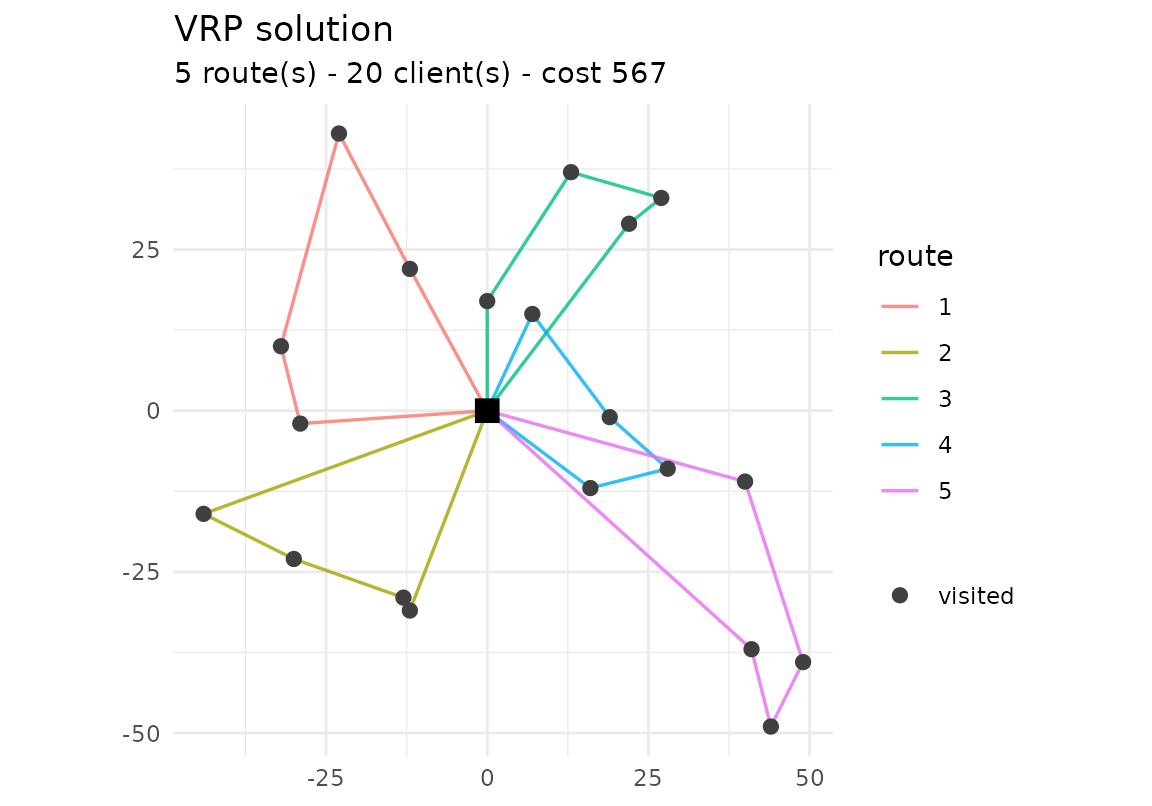
Stopping criteria
vrp_solve() runs until a stopping criterion fires.
Combine time- and iteration-based limits as needed:
vrp_solve(model, stop = max_runtime(seconds = 10)) # wall-clock budget
vrp_solve(model, stop = max_iterations(5000))      # iteration budget
vrp_solve(model, stop = no_improvement(1000))      # stop when stuck
Time windows (VRPTW)
Add tw_early, tw_late and
service columns to the clients to turn the model into a VRP
with time windows. The solver respects the windows, and
routes() reports the start_service and
wait time of each visit.
tw_clients <- tibble::tibble(
  x        = c(10, 20, 30, 40, 50, 60),
  y        = 0,
  demand   = 10,
  tw_early = c(0, 30, 60, 90, 120, 150),
  tw_late  = c(50, 80, 110, 140, 170, 200),
  service  = 10
)

vrptw <- vrp_model() |>
  add_depot(0, 0, tw_early = 0, tw_late = 500) |>
  add_clients(tw_clients) |>
  add_vehicle_type(num_available = 2, capacity = 60, tw_early = 0, tw_late = 500)

res_tw <- vrp_solve(vrptw, stop = max_iterations(500), seed = 1, display = FALSE)
routes(res_tw)[, c("route_id", "client", "start_service", "wait")]
#> # A tibble: 6 × 4
#>   route_id client start_service  wait
#>      <int>  <int>         <dbl> <dbl>
#> 1        1      1            50     0
#> 2        1      2            70     0
#> 3        1      3            90     0
#> 4        1      4           110     0
#> 5        1      6           150    10
#> 6        1      5           170     0
Heterogeneous fleet
Call add_vehicle_type() several times for a fleet of
different vehicles. Here a cheap type and an expensive one share the
same capacity; the solver prefers the cheaper type and only uses what it
needs.
het <- vrp_model() |>
  add_depot(0, 0) |>
  add_clients(clients) |>
  add_vehicle_type(num_available = 3, capacity = 50, unit_distance_cost = 1) |>
  add_vehicle_type(num_available = 3, capacity = 50, unit_distance_cost = 5)

res_het <- vrp_solve(het, stop = max_iterations(500), seed = 1, display = FALSE)
table(routes(res_het)$vehicle_type)
#>
#>  1  2
#> 12  8
Multiple depots (MDVRP)
Add several depots and base each vehicle type at one of them with
add_vehicle_type(depot = i). The routes()
output gains a depot column.
mdvrp <- vrp_model() |>
  add_depot(x = -50, y = 0) |>
  add_depot(x =  50, y = 0) |>
  add_clients(tibble::tibble(
    x = c(-55, -45, -50, 55, 45, 50),
    y = c(5, -5, 10, 5, -5, 8),
    demand = 10
  )) |>
  add_vehicle_type(num_available = 3, capacity = 50, depot = 1) |>
  add_vehicle_type(num_available = 3, capacity = 50, depot = 2)

res_md <- vrp_solve(mdvrp, stop = max_iterations(500), seed = 1, display = FALSE)
routes(res_md)[, c("route_id", "depot", "client")]
#> # A tibble: 6 × 3
#>   route_id depot client
#>      <int> <int>  <int>
#> 1        1     1      2
#> 2        1     1      3
#> 3        1     1      1
#> 4        2     2      5
#> 5        2     2      6
#> 6        2     2      4
Pickup and delivery (shipments)
A shipment pairs a pickup point with a delivery point: the
same vehicle must visit the pickup first and then the delivery, in the
same trip. Add shipments with add_shipments(); they can be
mixed freely with regular clients, time windows and every other
feature.
sh <- tibble::tibble(
  pickup_x   = c(-20, 10, 30),  pickup_y   = c(10, -25, 20),
  delivery_x = c(25, -15, -30), delivery_y = c(-10, 30, -20),
  amount     = c(4, 6, 3)
)

pdp <- vrp_model() |>
  add_depot(0, 0) |>
  add_shipments(sh) |>
  add_vehicle_type(num_available = 2, capacity = 10)

res_pdp <- vrp_solve(pdp, stop = max_iterations(300), seed = 1, display = FALSE)
routes(res_pdp)
#> # A tibble: 6 × 10
#>   route_id depot position activity client shipment  trip vehicle_type
#>      <int> <int>    <int> <chr>     <int>    <int> <int>        <int>
#> 1        1     1        1 pickup       NA        1     1            1
#> 2        1     1        2 pickup       NA        3     1            1
#> 3        1     1        3 delivery     NA        1     1            1
#> 4        1     1        4 pickup       NA        2     1            1
#> 5        1     1        5 delivery     NA        3     1            1
#> 6        1     1        6 delivery     NA        2     1            1
#> # ℹ 2 more variables: start_service <dbl>, wait <dbl>
The activity column distinguishes pickups from
deliveries, and shipment identifies the pair. Optional
shipments (required = FALSE, with a prize) may
be left out; unplanned() lists them.
Prize-collecting
Mark clients as optional with required = FALSE and give
them a prize. The solver visits an optional client only
when the prize offsets the routing cost;
unvisited_clients() lists those left out.
add_client_group() defines mutually exclusive
alternatives.
pc <- vrp_model() |>
  add_depot(0, 0) |>
  add_clients(tibble::tibble(
    x = c(5, -5, 0, 100, 100),
    y = c(5, -5, 8, 10, -10),
    demand = 10,
    required = c(TRUE, TRUE, TRUE, FALSE, FALSE),
    prize = c(0, 0, 0, 5, 500)
  )) |>
  add_vehicle_type(num_available = 4, capacity = 50)

res_pc <- vrp_solve(pc, stop = max_iterations(500), seed = 1, display = FALSE)
unvisited_clients(res_pc)
#> [1] 4
Reading standard instances
read_vrplib() and read_solomon() read
CVRP/VRPTW instances in the standard VRPLIB/TSPLIB and Solomon formats,
returning a vrpr_model ready to solve.
path <- system.file("extdata", "sample-n6-k2.vrp", package = "vrpr")
read_vrplib(path) |>
  vrp_solve(stop = max_iterations(200), seed = 1, display = FALSE) |>
  cost()
#> ✔ Read "sample-n6-k2": 5 clients, 1 depot, capacity 30, 2 vehicles.
#> [1] 68
Other variants
The same data boundary supports more variants:
-
Pickup & delivery / backhaul – add a
pickupcolumn to clients; the collected load counts toward capacity along the route. -
Multi-trip –
add_vehicle_type(reload_depots = i, max_reloads = k)lets a vehicle return to a depot to reload and run several trips.
See ?add_vehicle_type and ?add_clients for
the full set of options.